PDNode-600 is a new project currently in active development at DMT-Hardware. This post introduces the concept behind the device, explains the architecture, and gives a brief status update on where things stand.
So what is PDNode?
PDNode-600 is essentially the DC sibling of the ENERGIS project. While ENERGIS focuses on switching and managing 230 V AC outlets, PDNode is designed for environments where mains switching is unnecessary or undesirable, but controlled power distribution is still required. The goal is to provide a clean, rack-friendly, remotely manageable DC power platform built specifically for compact 10-inch rack systems.
At its core, PDNode-600 is a 600 W USB Power Delivery unit that provides 8 independent USB-C PD outputs and 4 auxiliary USB-A ports. Instead of distributing AC and switching it per outlet, the system uses a centralized industrial 20V power supply and distributes DC internally across the baseboard. Each port then performs its own power conversion locally on a dedicated PD card. This modular architecture keeps the baseboard simple while allowing individual PD channels to be developed, replaced, or upgraded independently.
The PD-Cards
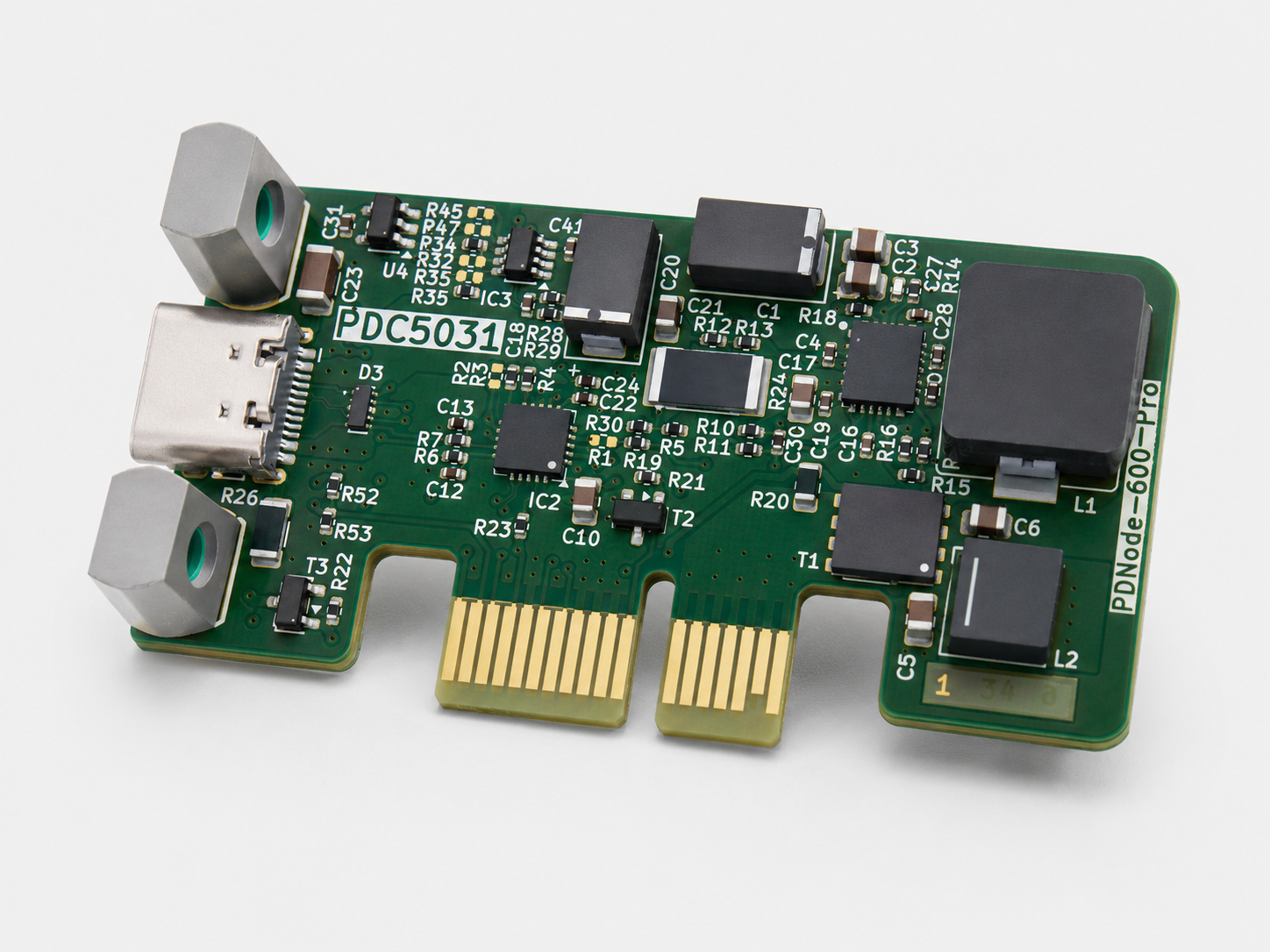
Each USB-C port in PDNode is implemented as a separate plug-in PD card. One card equals one USB-C port. The heart of the card is the MPQ5031, a USB-C Power Delivery controller. The power stage is handled by MPQ4232GVE, a 6A Buck-Boost converter. They handle the full PD negotiation process with the connected device and configures the output voltage accordingly.
Supported PD profiles include 5 V, 9 V, 12 V, 15 V and 20 V, with currents up to 3 A, or 5 A when an e-marked cable is detected. While each port can deliver significant power (100W!) individually, the overall system output is limited by the shared 600 W input budget.
Besides the PD controller, each card contains the complete local power stage required to generate VBUS from the 24 V internal bus, along with sensing circuitry for voltage and current monitoring. The card also exposes several status signals such as power-good and fault indicators, allowing the system controller to detect abnormal conditions.
By placing the entire power stage and USB-C interface on a removable module, the architecture stays flexible. Ports can be replaced, redesigned, or upgraded independently without requiring changes to the main board.
The Baseboard
The baseboard acts as the central distribution and coordination layer of the system. Its primary role is to distribute the 24 V DC rail from the main power supply to all PD card slots through a high-current internal power bus. Each slot provides power, communication, and control signals required for the PD cards to operate.
In addition to power distribution, the baseboard manages several slot-level functions. It handles card detection, slot enable control, and aggregation of status signals such as power-good and fault lines coming from the PD cards.
Communication with the cards is organized through an I²C multiplexer architecture. This allows identical circuitry to be used on every PD card without address conflicts, while still enabling the controller to communicate with each slot independently for monitoring and control.
The baseboard also hosts the auxiliary USB-A outputs, networking interfaces, and system infrastructure required for the full PDNode platform.
The Microcontroller - BladeCore-M54E
System control is handled by the BladeCore-M54E, a compact controller module designed as a reusable platform for rack and infrastructure projects. The module is built around the RP2354B microcontroller and integrates several essential system components, including external QSPI flash, configuration EEPROM, Ethernet connectivity through the W5500, and a USB service interface.
Within PDNode, the BladeCore module is responsible for coordinating all system functions. It communicates with the baseboard and PD cards, collects telemetry data, monitors port status, and controls slot behavior. Through the Ethernet interface, the controller provides a web-based management interface for monitoring and configuration. The long-term goal is to support remote management features such as SNMP integration, status reporting, and firmware updates, making PDNode suitable for unattended rack environments and automated test setups - just as it was done in ENERGIS.
Current status
The first prototype of PDNode-600 has been built and tested. During initial bring-up, several hardware issues were identified across the baseboard and PD card designs. These have been analyzed and corrected in the schematics, and the next step is ordering revision 2 of the PCBs with these fixes applied.
Development is currently progressing slower than planned due to unexpected workload on other fronts. Updates will follow as the revised hardware arrives and testing resumes - bear with us.